
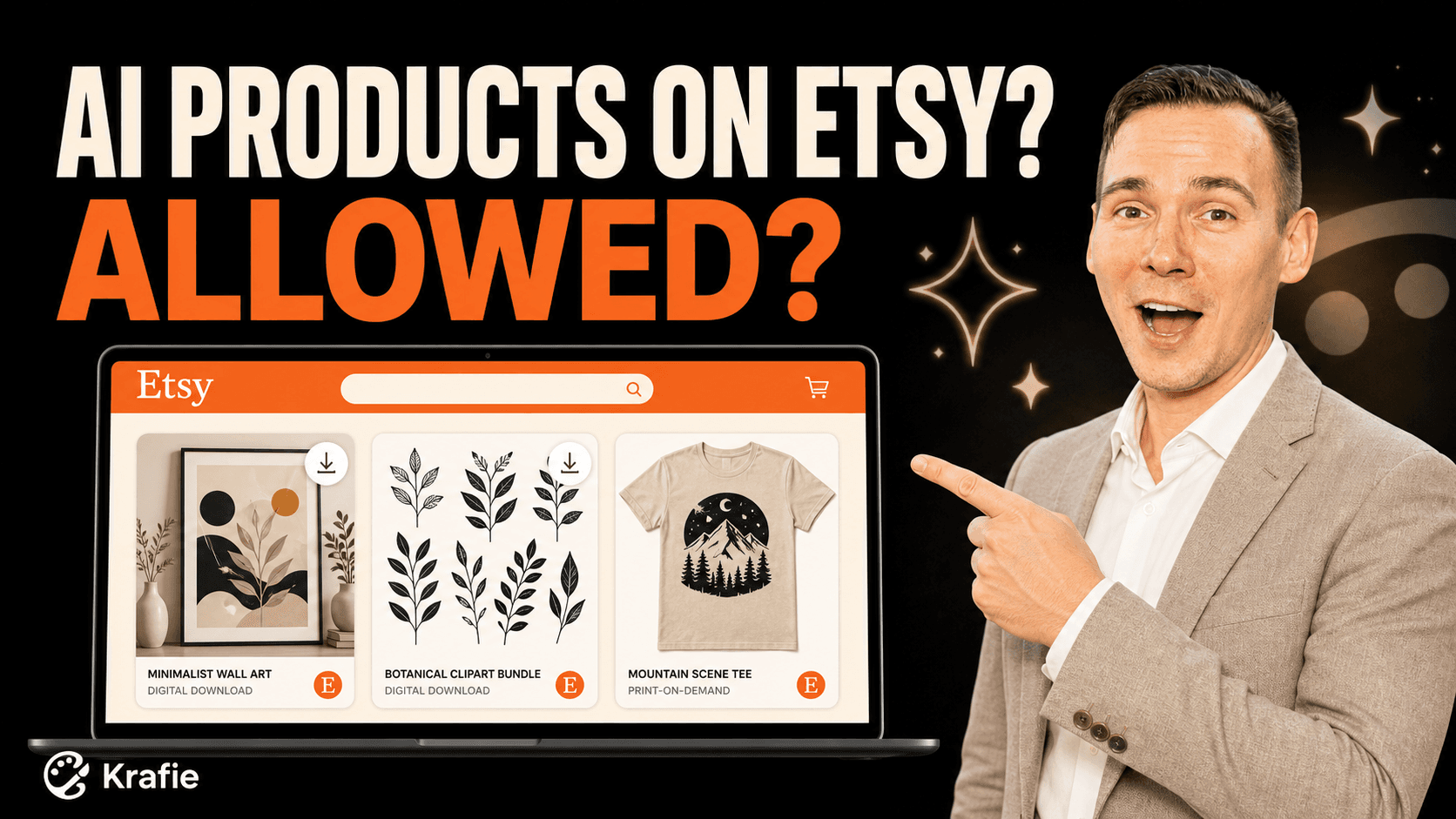
Yes, you can sell AI-generated products on Etsy. Etsy allows seller-prompted AI creations as digital downloads and also permits original AI-assisted designs to be printed on physical products by a disclosed production partner.
But “AI is allowed” does not mean everything made with AI belongs on Etsy. Your product still needs original seller input, an honest AI disclosure, accurate listing images, and respect for intellectual property. Print-on-demand sellers also have to disclose who manufactures and ships the physical item.
The short answer
AI digital downloads: allowed. AI designs on print-on-demand products: allowed. You must create the design, disclose AI use, disclose any production partner, and avoid copied IP, prompt bundles, dropshipping, and mass-produced resale items.
This guide breaks down Etsy's current rules, the difference between digital and print-on-demand listings, common suspension risks, and a practical creation workflow using Krafie.
Does Etsy Allow AI-Generated Products?
Yes. Etsy's current Creativity Standards specifically include “seller-prompted AI creations” under products designed by a seller.
Etsy gives examples such as:
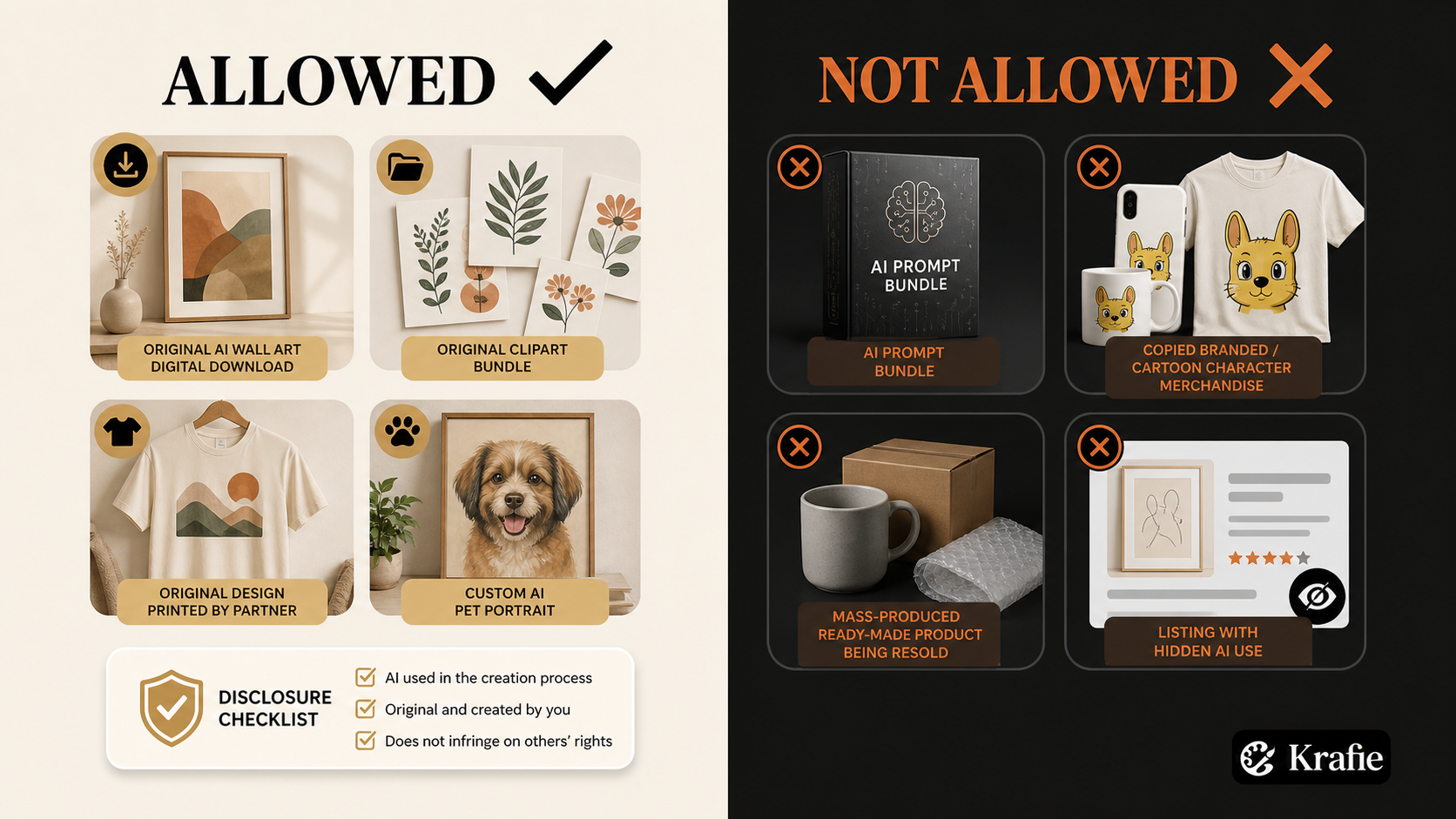
- a fantasy scene created from the seller's original prompt or inputs
- a custom portrait of a buyer's pet made with AI tools
- an original design sold as a digital download
- an original seller design printed by a production partner
The platform's separate AI creations guidance says sellers can use original prompts and AI tools to create artwork for sale. Etsy expects the seller to make creative decisions, guide the tool, curate the output, and turn it into a finished product.
That human contribution is the dividing line between using AI as a creative tool and uploading whatever a generator produces without review.
Digital Downloads vs. Print-on-Demand: What Changes?
AI digital products
You create and deliver the finished file directly to the buyer.
- Disclose AI use
- Deliver your original finished design
- No production partner needed
- No AI prompt bundles
AI print-on-demand products
You create the original design; a production partner prints and ships it.
- Disclose AI use
- Disclose the production partner
- Use accurate product and shipping details
- Do not resell ready-made goods
Printful, Printify, Gooten, apparel printers, engravers, and similar services can qualify as production partners when they manufacture an item from your original design. Etsy explains the distinction in its official guide to working with production partners.
8 Rules for Selling AI Products on Etsy in 2026
1. The design must come from your creative input
Etsy permits seller-prompted AI creations—not bundles of someone else's work and not mass-produced products you had no role in designing.
Use your own concept, prompts, references, edits, arrangement, typography, color decisions, and product preparation. Do not simply download another person's AI image, template, or PDF and relist it.
A good internal test is:
Can I clearly explain the decisions I made to create and finish this product?
If the only answer is “I found the file,” it probably does not meet Etsy's designed-by-a-seller standard.
2. Disclose that AI was used
Etsy's Seller Policy requires sellers to disclose AI use in relevant listings. Etsy's Creativity Standards specify that the disclosure should appear within the listing description.
Simple AI disclosure example
“This original design was created with the assistance of AI tools, then selected, edited, arranged, and prepared for sale by [Shop Name].”
Do not bury the disclosure behind vague wording. Clear language builds trust and protects buyers from assuming the product was made through a different process.
3. Sell a finished product—not an AI prompt bundle
Etsy allows the finished artwork created with AI, but its policy specifically prohibits AI prompt bundles. You can sell the resulting wall art, clipart, portrait, printable, or original design. You cannot list a package whose main product is a collection of AI prompts.
This is one of the clearest policy lines and an important SEO gap: “AI art” may be allowed while “AI prompts” are not treated as an eligible designed-by-a-seller product.
4. Print-on-demand must use your original design
Print-on-demand is allowed when the physical product is based on your original design. A printer can apply that design to a shirt, mug, blanket, poster, phone case, tote bag, or other item.
What is not allowed is using a white-label manufacturer or wholesaler to source a standard product that you simply rebrand and resell. Etsy's help page on dropshipping and reselling distinguishes seller-designed POD from prohibited resale.
5. Disclose your production partner
If another company prints or manufactures your item, add that company as a production partner and connect it to the relevant listings. Etsy asks sellers to accurately explain how they work with the partner and where the item ships from.
Production-partner description example
“I create and prepare every original design. My production partner prints the design on the selected product, packages the order, and ships it from [location].”
6. Make the listing images accurately represent the product
Etsy requires honest listing images and limits the use of stock photos, artistic renderings, and images used by other sellers. Production-partner and personalized products have limited exceptions, but the buyer still needs to see what the finished product will look like.
For digital downloads, show the actual file or realistic previews of it. For POD, use a mockup that matches the exact blank product, print placement, color, and proportions. Do not use an AI image that makes the shirt, mug, poster, or print quality look materially different from the item the buyer receives.
Etsy also says the first image for a personalized item should show a finished customized example—not a blank product with placeholder text.
7. Do not use copyrighted characters, brands, celebrities, or another artist's work
AI does not make infringement disappear. A generator can still produce recognizable characters, logos, celebrity likenesses, song lyrics, sports branding, or work that closely resembles another artist.
Etsy's Intellectual Property Policy makes sellers responsible for obtaining the rights they need. A listing can be removed after an infringement report, and repeated issues can put the shop at risk.
Safer product concepts use original themes, public-domain material you have verified, licensed assets whose terms permit your use, and your own creative elements. Avoid prompts such as “in the exact style of [living artist]” or “make this famous character wearing…”
8. Understand that permission to sell is not the same as copyright protection
Etsy may permit a product on its marketplace even when the purely AI-generated parts receive limited or no copyright protection in your country.
In the United States, the U.S. Copyright Office says copyright can protect human-authored expression, creative modifications, and sufficiently creative selection or arrangement. It does not extend copyright to purely AI-generated material merely because someone wrote a prompt.
This is general information, not legal advice. If your business depends on exclusive rights to a design, talk to a qualified intellectual-property professional in your jurisdiction.
What AI-Generated Digital Products Can You Sell on Etsy?
Original illustrations, abstract prints, nursery art, seasonal decor, and personalized designs.
Curated themed bundles with consistent style, clean backgrounds, useful formats, and clear licenses.
Pet, family, memorial, couple, and stylized portraits created from customer-provided references.
Cross-stitch patterns, coloring pages, planners, and printable layouts that you validate before selling.
Invitations, cards, labels, gift tags, games, and personalized celebration files.
Cut files and print graphics prepared for Cricut users, crafters, and print-on-demand sellers.
The product still has to work. An attractive AI crochet pattern that cannot be crocheted, a cross-stitch chart with impossible colors, or a printable with unreadable text can create refunds and negative reviews. Validate functional products before listing them.
For a product-by-product walkthrough, read How to Use Krafie to Generate and Sell Digital Products.
What AI Print-on-Demand Products Can You Sell?
Your original AI-assisted designs can be applied to products such as:
- t-shirts, sweatshirts, and hoodies
- posters, framed prints, and canvas
- mugs, tumblers, and water bottles
- tote bags, pouches, and backpacks
- blankets, pillows, and home decor
- phone cases, notebooks, and stickers
- personalized gifts and ornaments
The product category is less important than the chain of responsibility: you create the original design, the production partner manufactures it, and the listing accurately discloses both roles.
Do not assume a commercial-use license for somebody else's design automatically makes it an Etsy-compliant original seller design. Etsy's current Creativity Standards focus on designs created by the seller.
Create Digital Products With Krafie
Krafie combines the research and production tools needed for both digital downloads and POD:
- Product Research (Etsy listing data) to identify demand and new listing momentum
- AI Image Generator to create original concepts and assets
- Clipart Generator for consistent themed collections
- Background Remover for clean PNG designs
- Image Upscaler for print-ready resolution
- Mockup Generator for accurate listing previews
- Listing Optimizer (Etsy format) for titles and tags
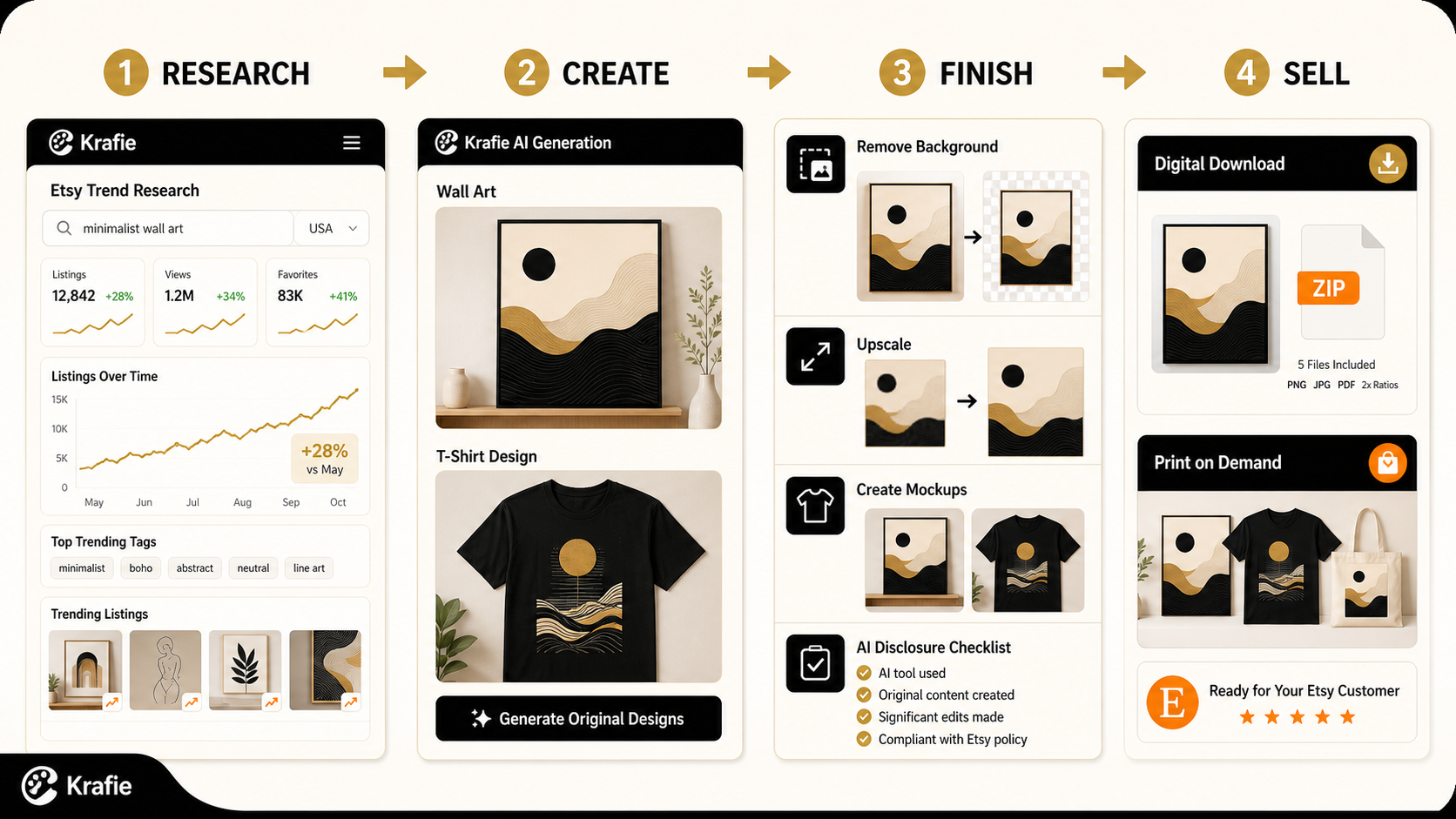
- Research demand. Find product types, themes, and keywords showing current momentum.
- Create an original concept. Use demand as direction, not as permission to copy another seller's art.
- Generate and curate. Produce variations, then choose the strongest result instead of uploading every output.
- Edit the product. Fix text, anatomy, edges, colors, dimensions, and composition.
- Prepare the files. Remove backgrounds, upscale, convert formats, and test the download or print file.
- Create accurate previews. Show the actual digital product or the correct POD blank and print placement.
- Write the listing. Add relevant SEO, an AI disclosure, and production-partner information where applicable.
- Order a sample for POD. Check color, sizing, placement, packaging, and shipping before scaling.
If you want an agent to help repeat the research and generation steps, Krafie's MCP connection can connect supported AI agents to specialized Krafie tools. The article on connecting Krafie and Claude shows the setup.
A Listing Checklist Before You Publish
- I created the original concept and design.
- I disclosed AI use in the description.
- I am selling a finished product, not an AI prompt bundle.
- I am not using protected characters, logos, lyrics, likenesses, or copied artwork.
- My files open correctly and functional products have been tested.
- My listing images accurately represent what the buyer receives.
- My production partner and shipping location are disclosed for POD.
- My title, tags, description, price, and product details are accurate.
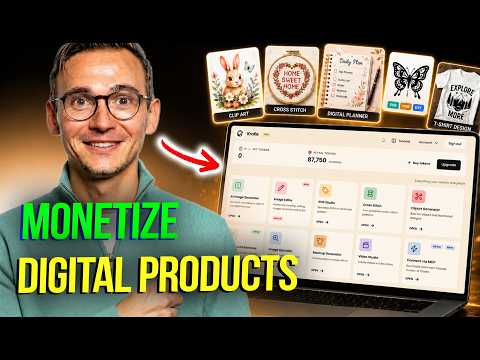
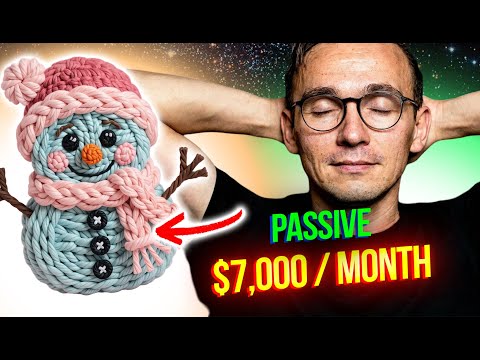
Watch These Etsy AI Product Videos
These videos show the broader Krafie workflow and real Etsy business examples:

Frequently Asked Questions
Can you sell AI art on Etsy?
Yes. Etsy permits seller-prompted AI art when it comes from the seller's original prompts or inputs and the seller discloses AI use in the listing description.
Can you sell AI-generated digital downloads on Etsy?
Yes. Original finished digital products such as wall art, clipart, portraits, printables, SVGs, and patterns can qualify. The files must be made or designed by the seller and follow Etsy's other policies.
Can you sell AI print-on-demand products on Etsy?
Yes. You can use an original AI-assisted design on a physical item produced by a POD partner. Disclose both the AI use and production partner, and accurately represent the finished item.
Do you have to disclose AI art on Etsy?
Yes. Etsy's current Seller Policy and Creativity Standards require disclosure when an item was created through the use of AI.
Can you sell AI prompts on Etsy?
Etsy specifically prohibits AI prompt bundles. The platform allows finished seller-prompted creations, not prompt packages sold separately from the finished artwork.
Is print-on-demand the same as dropshipping on Etsy?
No. Seller-designed POD can qualify because a disclosed production partner manufactures the seller's original design. Dropshipping or reselling a standard ready-made product that the seller did not design generally does not qualify.
Can you use copyrighted characters in AI Etsy products?
Not without the necessary rights. AI-generated content can still infringe copyrights, trademarks, publicity rights, and other protected interests.
Does Etsy own your AI-generated design?
Etsy's permission to list a product is separate from copyright ownership. The protection available for AI-assisted work depends on the law in your jurisdiction and the amount of human-authored expression.
Final Answer: Yes, but Build a Real Product
You can sell AI-generated products on Etsy as digital downloads or print-on-demand items. The safest long-term approach is to use AI as part of a genuine creative workflow:
- research a real customer need
- create an original concept
- curate and edit the result
- prepare a useful finished product
- disclose AI and production assistance
- avoid IP and resale shortcuts
Krafie brings the research, generation, editing, mockup, SEO, and automation pieces into one workspace.
Start creating digital products with Krafie